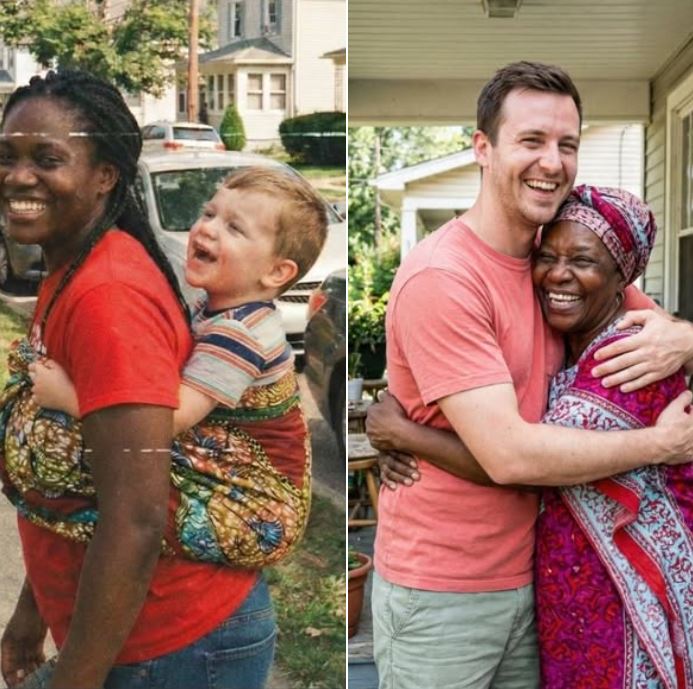

I hadn’t heard her name spoken aloud in more than twenty years—yet it lived somewhere deep inside me, in the space where childhood memories blur into feelings rather than details. A warmth, a voice, a steady pair of hands guiding me through mornings that would’ve otherwise been chaos.
But it wasn’t until my father got sick that her name resurfaced with clarity. Miss Linda.
The way he said it—soft, nostalgic, almost guilty—made something tighten in my chest. Dad wasn’t the emotional type. He loved through actions, not words. He showed up, he worked hard, he fixed things around the house, he stayed up late to help me with homework even when his hands shook from exhaustion.
But that day, sitting on the edge of his hospital bed, he stared at the floor and whispered, “I hope she’s alright. I hope she knows how much she meant to us.”
That was the moment I decided I had to find her.
I owed it to him.
I owed it to myself.
And above all, I owed it to the woman who had been more than a babysitter—more than a neighbor—at a time in my life when stability was rare and every dollar counted.
The Name That Started Everything

Months passed before I finally committed to searching for her. Life had a way of distracting me—work, bills, deadlines, responsibilities that piled up faster than I could manage. But every time I visited my dad, he asked the same question:
“You remember Miss Linda, don’t you?”
I’d nod, even though remembering was complicated. Childhood memories are fragile things—sometimes a smell remains while the face disappears; sometimes a voice returns but the conversations fade. Yet every memory I had of her was warm. Loving. Safe.
My parents worked double shifts when I was small. They were trying to claw their way out of a financial hole that felt impossible at the time. Rent swallowed most of the paycheck. Gas and groceries took the rest. There were nights we ate rice with butter because stretching a meal meant surviving another week.
And in the middle of that, Miss Linda stepped in—not out of obligation, not because she owed us anything, but because that’s who she was.
She carried me to daycare when my parents had to leave before sunrise. She watched me in the afternoons. Some nights she fed me dinner because my parents were still working. When money was tight, she didn’t ask for payment. She just smiled and said, “He’s fine here. Go do what you need to do.”
She held us together so quietly that I didn’t realize the magnitude until adulthood.
Dad would say, “We wouldn’t have made it without her.”
And I believed that.
So I started searching.
Digging Through the Past
Finding someone without social media, without recent records, and without a clear address is harder than you think. I didn’t even know her last name at first. To me, she was always just Miss Linda.
I pulled out old school papers. Notes in the margins. Yearbooks. Church bulletins my dad kept stuffed in drawers. Anything that might contain a surname, an address, a clue.
I didn’t realize how emotional that process would be. Every page felt like uncovering an archaeological artifact of my own childhood—the handwriting of teachers long gone, drawings I made when I still believed monsters lived under the bed, report cards stapled together with comments about “Marcus is doing better this semester.”
She had been part of that stability.
Then, buried in a faded folder, I finally found her name:
Linda Brooks.
My heart jumped.
But a name wasn’t enough.
I searched phone books.
Called old neighbors.
Reached out to anyone who might have lived in the same ZIP code twenty years ago.
Most numbers were disconnected.
Most people didn’t remember.
Most streets had changed, as neighborhoods do over decades.
But then I called a number on an old church volunteer list. The woman who answered sounded surprised when I asked about Miss Linda.
“Oh Lord,” she said. “I haven’t heard her name in years. But yes—Linda Brooks. Still around, I think. Bad knees now. Doesn’t get out as much. But she’s still helping people when she can. Still in the same neighborhood, last I heard.”
I wrote the address down with shaking hands.
I didn’t even wait 24 hours.
I got in my car the next morning while the sun was barely waking up.
The Road Back Home
Driving across the country gives you time to think—too much time, maybe. Memories drifted in and out as the miles passed:
• Her calling me “baby boy” even when I insisted I was big.
• The way she tied my shoes—double knots so I wouldn’t trip.
• The smell of fried apples and biscuits coming from her kitchen.
• Her humming gospel songs when she thought no one was listening.
• Her telling my parents, “He’s safe with me. You go work.”
She filled cracks in our life that I didn’t even know were cracks until I grew up and understood what stress looks like on a parent’s face.
I didn’t remember all the details.
But I remembered the feeling.
And sometimes that’s enough.
When I finally reached the neighborhood, I didn’t recognize much. Houses had new paint. Lawns were fenced. The big oak tree I used to climb was gone. But the little blue house on the corner—the one with the faded porch swing—was still standing.
Her house.
I parked across the street and just sat there. My hands were gripping the steering wheel so tight my knuckles were white.
What if she didn’t remember me?
What if she wasn’t the same?
What if I had waited too long?
But something—maybe hope—pushed me out of the car and up the walkway.
I knocked.
The Door That Opened More Than a Memory
When the door swung open, a small woman stood there, leaning slightly on the frame. She had more gray hair now. Softer lines around her mouth. But her eyes—those warm, steady eyes—were the same.
“Can I help you?” she asked.
I swallowed hard.
“My name is Marcus,” I said. “I… I’m the kid you used to carry to daycare when my parents worked early shifts. You helped take care of me when I was little.”
Her eyes widened—fast, sharp, like something clicked into place.
“Marcus?” she whispered.
I nodded.
The porch creaked as she stepped forward. Then her hand flew to her mouth the way people do when emotion hits them before sound can. She reached out, touching my arm like she needed proof I was real.
“Lord have mercy,” she said. “Look at you. Grown.”
Her voice cracked on that last word.
And something in me cracked too.
For a second, I wasn’t thirty. I was five years old again, holding her hand on the way to daycare with my shoes untied and my backpack dragging on the ground.
She pulled me into a hug—small arms but strong, familiar in a way I didn’t expect. It felt like closing an unfinished chapter. Like something inside me shifted into place, finally.
When she let go, she wiped at her eyes.
“I didn’t think I’d ever see you again,” she said.
“I came to thank you,” I told her. “My dad… he’s been talking about you a lot. I realized I never told you how much you helped us.”
She pressed her palm to her chest. “Your daddy was a good man. Your mama too. They just needed help. And helping… well, that’s what neighbors are for.”
Coffee, Memories, and the Years Between
She invited me inside. The house smelled exactly like it did decades ago—warm, comforting, a little like cinnamon and soap. I noticed the walker near the couch, the neatly organized medication bottles by the lamp, the worn quilt draped over the recliner.
Life had carried her through its own battles.
She didn’t mention them.
She never had been the type to talk about her struggles.
We sat at her kitchen table with mismatched mugs. She asked about my life—my job, my family, my dad’s health. She listened the same way she always had, with full attention and no judgment.
Family games
I told her how much she meant to us.
How my parents would never forget her kindness.
How I wouldn’t either.
At some point, she reached over and held my hand.
“You were a good boy,” she said softly. “Smart. Kind. You had such a big heart even then. I always prayed life wouldn’t harden it.”
I felt my throat tighten. “I think you’re part of the reason it didn’t.”
She squeezed my fingers.
That was all she needed to hear.
A Missing Piece Returned
I stayed for hours. She showed me old photos she kept in boxes—some of kids she had cared for over the years. Some of family members long gone. And in one small frame, buried behind others, was a picture of me at age five, grinning with missing front teeth and wearing a jacket three sizes too big.
“You kept this?” I asked.
She smiled. “Of course. You were my baby too.”
When I finally stood to leave, she walked me to the door slowly, leaning on her cane but refusing help.
“Don’t wait another twenty years,” she said.
“I won’t,” I promised.
She hugged me again—longer this time, like she didn’t want to let go. And maybe I didn’t either.
Walking back to the car, I felt something I hadn’t felt in years. Closure. Gratitude. Peace.
Finding her didn’t just answer a missing part of my past.
It reconnected me with the kind of love that holds people together in the hardest times—quiet, unseen, uncelebrated, but powerful enough to change the course of a family’s life.
When I drove away, I saw her still standing on the porch, waving until my car turned the corner.
And that’s when I realized:
I hadn’t just found Miss Linda.
I found a piece of myself too.