
In a world where the harsh realities of homelessness are often swept under the rug, the story of 88-year-old Elijah and Deputy Carter stands as a powerful reminder of the humanity that still exists in the most unexpected places. It’s a story of empathy, respect, and the quiet moments that change lives. It’s a story that begins with an uncomfortable call to the police and ends with a simple act of kindness that no one could have anticipated.
This is the story of how a Vietnam veteran, alone and forgotten, found not just warmth from a dryer but the warmth of human kindness, all thanks to one officer’s decision to see beyond the uniform and the badge.
1. The Call That Started It All
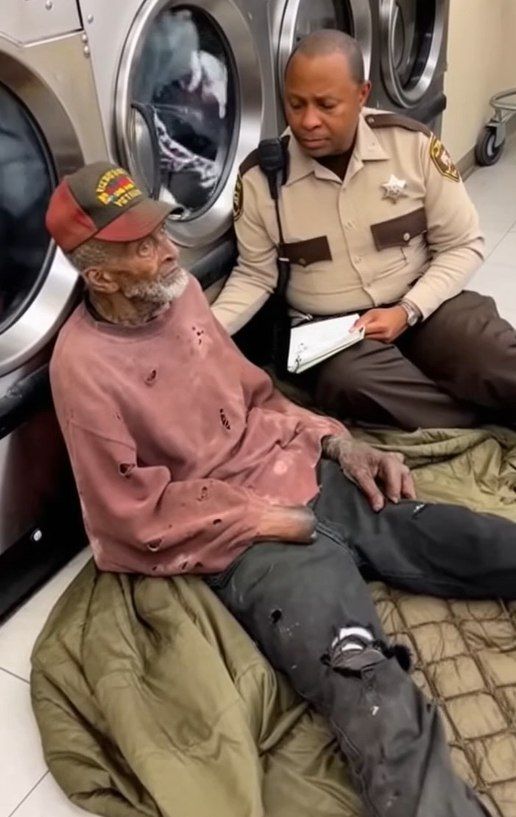
It was a bitter, freezing night when Elijah, an elderly homeless man, took refuge in a 24-hour laundromat. The laundromat was one of the few places still open at that hour, and its dryers offered a brief respite from the cold. At 88 years old, Elijah had nowhere else to go. His clothes were tattered and full of holes, a testament to years of hardship and neglect. He sat down on the cold linoleum floor, leaning his back against the warmth of a running dryer, trying to stave off the cold and exhaustion.
In a world that often overlooks people like Elijah, a customer inside the laundromat felt uncomfortable seeing him there. Rather than offering assistance, the customer called the police, complaining about the “vagrant” sleeping in the corner of the laundromat. The call was made under the premise of “loitering and trespassing,” a common issue that law enforcement often handles with detachment.
It was a standard call. Nothing out of the ordinary. The police would show up, ask the man to leave, and the matter would be over. Or so everyone expected.
2. Deputy Carter’s Response: A Different Approach
When Deputy Carter arrived on the scene, he was prepared for the usual protocol: ask the man to leave, write a report, and move on to the next call. However, as he approached Elijah, something about the situation stopped him in his tracks.
It wasn’t the tired, hunched figure of the old man. It wasn’t even the uncomfortable scene of a homeless person in a public space. It was the hat.
Elijah wore a cap that read: “Vietnam Veteran.”
Carter had seen the hat before. He knew the significance of it. A Vietnam veteran, struggling with life in his later years, alone and forgotten by society. Something clicked in his heart as he looked at Elijah’s face—weather-beaten, tired, and scared. Carter didn’t see a suspect in front of him. He saw a man who had given so much to his country and was now abandoned and cold, seeking warmth and dignity in the only place that offered it.
Rather than walking up to Elijah and demanding he leave, Carter made a decision that would change both their lives. He didn’t use his “command voice” or stand over the old man as an authority figure. Instead, he did something that shocked everyone in the laundromat.
3. The Gesture of Compassion: Sitting on the Floor with Elijah
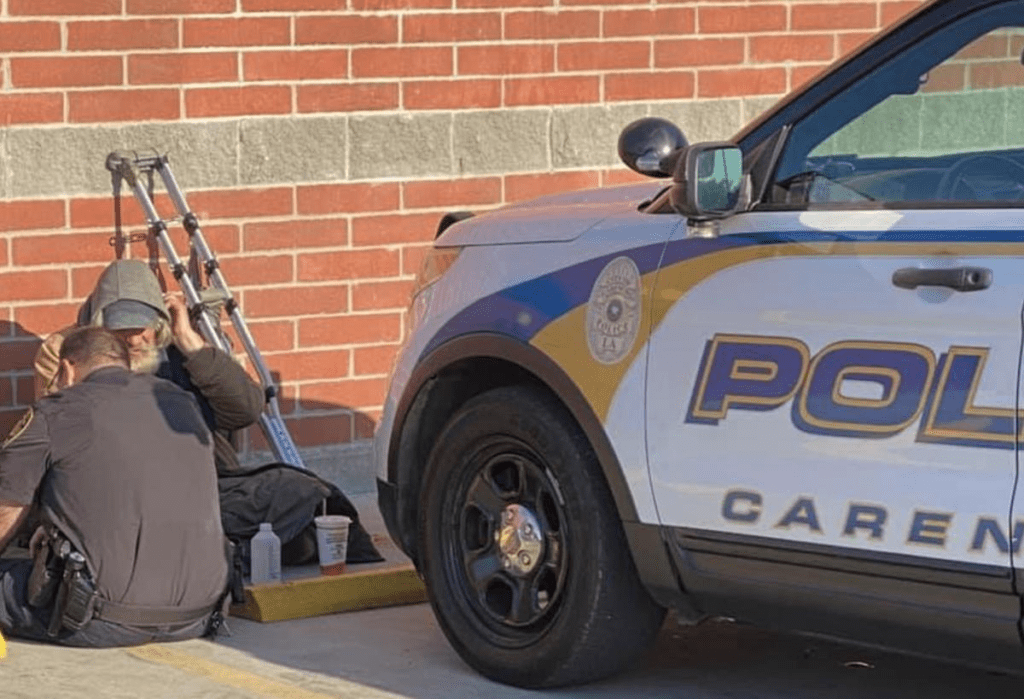
In a moment of profound empathy, Carter lowered himself onto the cold, dirty floor beside Elijah. He didn’t hover over him or give him orders. He sat down. He crossed his legs and sat shoulder-to-shoulder with the elderly man, at eye level.
“It’s warm here, sir,” Carter said softly, pointing to the dryer.
Elijah, expecting to be kicked out into the cold, looked up at Carter’s badge and said, “It’s the only warm place I got. Been to a lot of beds, officer. None felt like home.”
The words stung. They revealed the deep sense of loneliness Elijah had felt for so long. His life, once filled with purpose and service, had devolved into a series of fleeting, uncomfortable nights in shelters, without a sense of security or comfort. He had served his country, only to find himself cold, alone, and disregarded in his final years.
4. The Power of Listening: Building Trust and Connection
Carter didn’t rush Elijah or try to force him into making decisions. Instead, he stayed with him. For twenty minutes, Carter sat on the floor, just listening to Elijah’s story. The officer didn’t treat him like a problem to be solved or a suspect to be handled. He treated him like a superior officer — with respect, kindness, and dignity.
Through their conversation, Elijah shared the weight of his life: his service in Vietnam, his years of hardship, and the overwhelming feeling of isolation that had led him to this point. Carter listened without interruption, acknowledging Elijah’s struggles, and allowing him to express himself freely. It wasn’t just about the immediate solution—it was about giving Elijah the respect and validation that had long been denied to him by society.
5. A Compassionate Promise: Offering More Than Just Shelter

As the conversation continued, Carter realized that Elijah wasn’t just seeking warmth from the dryers. He was seeking safety. He was seeking human connection. And above all, he was seeking to feel seen, to feel valued again.
In that moment, Carter made a promise to Elijah that went beyond offering a warm meal or a temporary solution. He told Elijah that he knew of a place for veterans — a real place, with a real bed, and not just a cot in a gym. It was a place where Elijah could find not just shelter but a sense of belonging and peace.
Carter didn’t just offer Elijah a room for the night. He offered him a chance at dignity. He offered him the opportunity to reclaim something that had been taken from him over the years: a place where he could feel like a human being again, with his history, his sacrifices, and his struggles acknowledged.
6. Taking Action: Moving from Words to Help
With trust built between them, Carter gently encouraged Elijah to stand. It wasn’t an easy step for the elderly man, who had grown weary from years of hardship. But with Carter’s help, Elijah managed to get to his feet.
And instead of being escorted to a squad car’s backseat, they walked out of the laundromat together. They walked to a place of refuge, not just a bed, but a sense of safety. Carter didn’t treat Elijah like a criminal or an inconvenience. He treated him with the respect that every human being deserves.
7. The Significance of Compassionate Policing

Deputy Carter’s decision to sit with Elijah on the floor was not just an act of kindness — it was an example of compassionate policing. In an age where law enforcement is often scrutinized for its interactions with marginalized communities, Carter’s approach represents a model of how police officers can bridge the gap between authority and empathy.
This moment, quiet as it was, serves as a reminder that police officers don’t just enforce laws—they are part of the fabric of the community. They have the power to show compassion, understanding, and care in ways that transcend the traditional role of an enforcer. Through his actions, Carter demonstrated that police officers can be both protectors and human beings who offer empathy and kindness.
8. A Call to Action: Supporting Vulnerable Populations
While this story of compassion and kindness is heartwarming, it also serves as a reminder that homelessness, particularly among the elderly and veterans, is an ongoing issue in many communities.
Elijah’s situation is not unique. Veterans, elderly individuals, and those living with mental health issues or addiction often find themselves isolated and without resources. Many veterans, like Elijah, return from service only to face the challenges of reintegration into society, and without proper support systems, they often fall through the cracks.
This story calls for greater efforts to:
- Provide better mental health care and support for veterans.
- Increase access to affordable housing and long-term care for the elderly.
- Foster compassion in communities for individuals who are struggling with homelessness.
- Build more programs that offer dignity and respect to vulnerable populations.
A Moment of Humanity in a Busy World
The story of Deputy Carter and Elijah is a story of what it means to be human, to see beyond the labels and circumstances, and to offer a helping hand when someone needs it most. It reminds us that sometimes, the most powerful actions are the smallest ones — a decision to sit on the floor with someone, to listen, to offer comfort and compassion.
It’s easy to get caught up in the daily grind of life, but moments like this show us that true leadership lies in how we treat others when no one is watching, how we lift each other up when the world seems indifferent.
For Elijah, the night ended not in a laundromat but in a place where he could rest and feel safe. For Deputy Carter, this was more than a routine call—it was a reminder of the deep impact a small act of kindness can have.
As we look to our communities and our public servants, let us remember that compassion can heal, dignity can restore, and kindness can make a world of difference.