

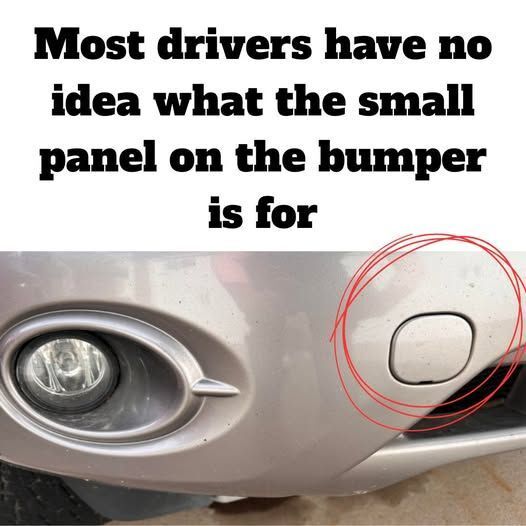
If you’ve ever noticed a small square or rectangular panel on the front or back bumper of your car, you might have assumed it was just a decorative design choice. But that tiny flap actually hides one of your vehicle’s most important—and often overlooked—safety features.
Behind that smooth cover is the tow hook socket, a built-in connection point designed to help safely tow your car when you’re stuck or stranded. It’s one of those features most drivers never think about until they desperately need it.
What the Hidden Panel Actually Does
Most modern vehicles are designed with sleek, aerodynamic lines. To keep that clean look, car manufacturers hide the tow hook socket behind a small removable panel. Pop that panel off, and you’ll find a threaded metal insert—ready to receive a sturdy tow hook.
The tow hook itself is usually included with your car’s emergency kit, often stored in the trunk near the spare tire or jack. It looks like a short metal rod with a loop at one end and a threaded tip at the other.
When your car breaks down, slides into a ditch, or gets stuck in snow or mud, that little hidden socket becomes your lifeline. Instead of trying to attach a cable or chain to fragile parts like the bumper, frame, or suspension, a tow truck driver (or another motorist) can screw the hook securely into that socket. This gives a stable, factory-approved connection point that won’t damage your car’s structure.
How to Use It in an Emergency
- Find the Panel: Look at the center or corner of your bumper for a small, square or circular flap—often flush with the paint. Some have a subtle outline or a tiny indentation for easy removal.
- Remove the Cover Gently: Use a flat object, like a key or the edge of a coin, to pop it off. Be careful not to scratch the paint.
- Locate the Tow Hook: Check your trunk near the spare tire compartment or under the cargo floor. It’s typically stored with the tire tools.
- Screw in the Hook: Align the threaded end of the hook with the socket behind the panel and twist clockwise until it’s snug. It should feel secure and solid—never loose.
- Attach the Tow Line: Once in place, the hook provides a reinforced anchor for a tow strap, rope, or cable. This allows your car to be pulled safely without damaging the bumper or undercarriage.
Why It Matters More Than You Think
If your vehicle ever ends up stuck—on a snowy hill, muddy road, or even a flooded area—trying to pull it out the wrong way can cause serious (and expensive) damage. Many bumpers today are mostly lightweight plastic designed for aerodynamics, not strength. Even tying a tow line to an axle or wheel suspension can bend parts or tear components loose.
That small panel prevents all of that by giving you a purpose-built spot that’s strong enough to handle the strain. It’s not just about convenience—it’s about safety.
Why You Might Have Two of Them
Some vehicles come with tow hook covers on both the front and rear bumpers, allowing flexibility depending on whether you need to pull the car forward or backward. Others have just one, typically on the front.
If your panel is missing or damaged, replacements are inexpensive and easy to order from your car’s manufacturer or an auto parts store. They simply snap back into place, keeping the socket protected from dirt and debris.
A Small Detail With a Big Purpose
The next time you’re washing your car or parked in the driveway, take a closer look at your bumper. That small, almost invisible panel isn’t there for style—it’s there for safety.
It’s the hidden feature that can make the difference between a smooth roadside rescue and an expensive repair bill. In the right moment, it might even save your life.
So, keep your tow hook handy, know where that panel is, and remember: even the smallest car parts can have a purpose far greater than they appear.


